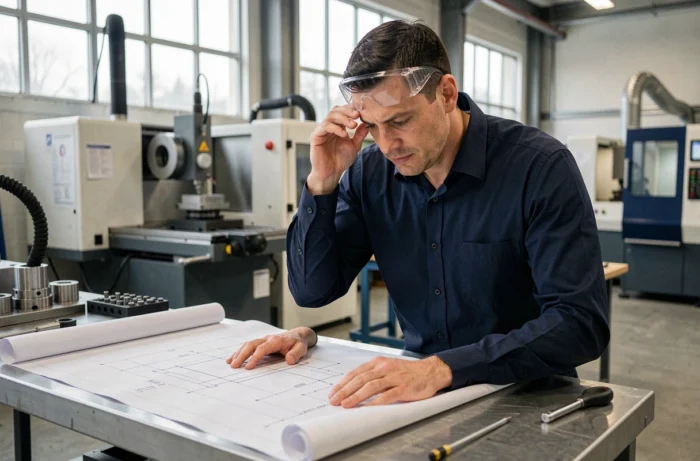
The technical job market in Switzerland clearly distinguishes profiles according to their qualification level. Job offers for field industrial professions (electromechanics, installers, production technicians) remain numerous in several cantons, while positions for R&D engineers or research-oriented scientists have seen their listings decrease by about 18% year-on-year in the second quarter of 2026. Understanding this segmentation before applying helps avoid wasting weeks on saturated sectors.
Decoupling between field technicians and R&D engineers in Switzerland
The Swiss technical sector does not form a homogeneous block. Professions in mechanical engineering, industrial installations, electronics, and production are among the most sought-after categories in Eastern Switzerland, Central Switzerland, the Mittelland, Neuchâtel, and Geneva.
A profile of skilled worker or field technician currently has a better chance of being recruited quickly than a highly qualified engineer in natural sciences. The professions in this latter group represent the segment most affected by the decline in job vacancies.
For a candidate aiming for speed, the first reflex is to check if their specific profession is among the in-demand functions in the targeted canton. Specialized platforms for technical placement, such as techna-personal.ch, centralize temporary and permanent positions in these industrial sectors and allow targeting regions where demand remains strong.
Romandy and German-speaking cantons: where to apply based on technical specialty
The canton of Geneva and the canton of Vaud concentrate a significant share of technical offers in French-speaking Switzerland, particularly in production, watchmaking, and quality professions. A French speaker who does not master German should prioritize these two cantons.
Neuchâtel has a particular profile due to its watchmaking and microtechnology fabric. Companies there seek very specific profiles (setters, operators on CNC machines, micromechanics technicians). Competition among candidates is often less intense than in the Léman arc, provided they have the corresponding skills.
In German-speaking Switzerland, Eastern Switzerland and the Mittelland display recurring needs for industrial technicians. Applying in these regions requires preparing one’s application in German and accepting that interviews may partially take place in dialect. Bilingualism accelerates the job search by several weeks compared to a monolingual French-speaking candidate.
Watchmaking and microtechnology: short recruitment timelines
Watchmaking companies operate with tight production cycles. When a technical position opens up, recruitment rarely lasts more than a few weeks. Monitoring job postings daily on French-speaking portals (jobup.ch, jobs.ch) and responding within 48 hours increases the chances of being called for an interview before the position closes.
Temporary employment in Switzerland: accelerator or dead end for a technician
Temporary work represents a quick entry point into the Swiss technical sector. Specialized placement agencies offer assignments ranging from a few weeks to several months in production, maintenance, or installation.
- Main advantage: the time between application and starting the job can be reduced to less than two weeks, compared to one to three months for direct recruitment.
- Temporary work allows testing an employer, a canton, and a work environment without long-term commitment.
- In Switzerland, the collective agreement for temporary work guarantees regulated salary conditions, even for short assignments.
- A temporary contract frequently leads to a permanent hire if the skills match the company’s needs.
There is a risk of getting stuck in a succession of assignments without progression. To avoid this, it is essential to negotiate from the start with the agency the possibility of transitioning to a permanent position and to prioritize assignments with companies that are actively hiring.
Technical application file: Swiss codes that make a difference
Swiss recruiters expect a complete application file, not just a simple CV accompanied by a generic email. The local standard includes a detailed CV (two to three pages accepted), a personalized cover letter for each position, copies of diplomas, and work certificates from previous employers.
The absence of work certificates is a negative signal for a Swiss recruiter. In Switzerland, every employer provides a certificate at the end of the contract. A foreign candidate who does not have one must provide equivalent attestations or translated letters of recommendation.
Adapting the CV to local technical vocabulary
Job titles differ between France and Switzerland. A French “maintenance technician” often corresponds to a “service technician” or “after-sales technician” in Swiss job postings. Using the exact terms from the job offer in the CV increases the visibility of the application, especially when companies use automatic filters.
- Mention specific certifications (ISO standards, electrical qualifications, Swiss or European driving licenses) directly under the CV title.
- Indicate language proficiency according to the CEFR scale (A1 to C2), the standard reference in Switzerland.
- Specify geographical availability and possible start date: technical recruiters often filter by entry time frame.
The unemployment rate in Switzerland remains relatively low (around 3% in 2026 according to SECO), but this average masks significant disparities between professions and cantons. A file tailored to local expectations measurably reduces job search time compared to an application formatted for the French market.
Technicians who target the right cantons, go through specialized placement, and refine their application according to Swiss codes shorten their job search period to a few weeks rather than several months.