
A poorly sized hedge trimmer turns routine trimming into a chore. Blades too short for a laurel hedge, a battery that dies halfway through, weight that numbs the arms after ten minutes: the choice of this tool determines both the quality of the cut and the comfort of the gardener. Before comparing models, it’s essential to ask the right questions, and they don’t all concern the motorization.
Branch diameter and tooth spacing: the criterion that the product sheet does not highlight
Most guides immediately direct you towards the type of power supply. The first filter should be the nature of the hedge itself. A boxwood or privet hedge, trimmed two to three times a season, only produces fine twigs. A cherry laurel or hornbeam hedge left for several months generates woody branches of a completely different caliber.
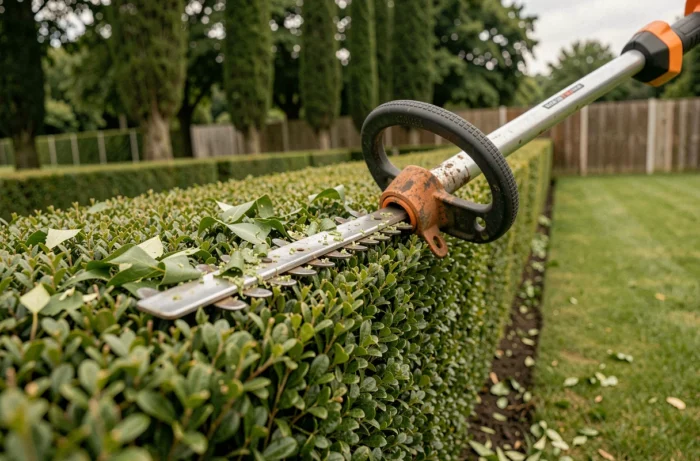
The spacing between the teeth of the blade determines the maximum cutting diameter. A narrow spacing is suitable for young hedges and topiaries. A wider spacing accommodates thicker branches but allows fine twigs to slip through without cutting them cleanly. The tooth spacing must correspond to the actual diameter of the branches, not to the theoretical power of the motor.
Online catalogs, like those listed on taille-haie-warrior.com, generally display this technical data. Checking it before purchase prevents a return or, worse, a tool that you force until it gets damaged.
Blade length and terrain configuration
A long blade covers more surface in one pass. Logical. What is less measured is the trade-off: a long blade is heavier, vibrates more, and lacks maneuverability in angles, curves, and the lower parts of the hedge.

For a narrow and low hedge, a short blade offers significantly greater precision. For a wide and tall hedge bordering a property over several dozen meters, a longer blade reduces the number of passes and thus the accumulated fatigue.
The blade length should be chosen based on the width and height of the hedge, not the prestige of the technical sheet. A gardener trimming a boxwood hedge into a square with an oversized blade achieves an uneven result.
Tall hedges: the question of the pole
Hedges that exceed shoulder height pose a safety and posture problem. A pole hedge trimmer (telescopic) avoids the use of a stepladder, but its cantilevered weight puts significant strain on the arms and back. Field feedback varies on the actual comfort of these models beyond a few minutes of continuous use.
If the hedge to be trimmed at height represents only a small portion of the total length, a classic model supplemented by a stable step stool often remains more comfortable than a pole model used across the entire job site.
Hedge trimmer motorization: battery, corded, or gas
The type of power supply comes in third in the logical decision order, after the hedge itself and the blade length. Each motorization imposes different compromises.
- The corded electric hedge trimmer remains the lightest and cheapest to purchase. Its power is constant as long as it is plugged in. The constraint of the cable limits its range and requires constant vigilance to avoid cutting the extension cord.
- The battery model offers complete freedom of movement. Battery life depends on the voltage and capacity of the battery, and it varies according to the thickness of the branches being cut. The same model can last half as long on dense laurel as on fine privet.
- The gas hedge trimmer delivers the highest power and operates without time limits. In return, it is heavier, noisier, and requires regular mechanical maintenance (spark plug, air filter, oil-gas mixture).
For a medium-sized garden with a hedge accessible from an outdoor outlet, the corded option remains a rational choice that many dismiss too quickly in favor of the battery. The gas option is only justified for long stretches or very dense old hedges.
Weight, ergonomics, and vibrations: what matters after the tenth minute
The first gestures with a hedge trimmer reveal nothing. It is after several minutes of work with arms raised that weight becomes a determining factor. A difference of a few hundred grams between two models translates, over a one-hour session, into very different muscle fatigue.
Some manufacturers integrate a rotating handle that allows the blade to be tilted without twisting the wrist. Others offer a more or less effective anti-vibration system. Testing the grip before purchase remains the only reliable way to assess actual comfort.
Safety features are not optional. A hand protection shield, a quick blade brake system, and a double start switch (which prevents accidental triggering) constitute the minimum foundation to check on any model.
Noise regulations and trimming periods
A hedge trimmer, regardless of its type of motorization, produces noise that is subject to regulation. Article R1336-5 of the Public Health Code regulates noisy devices. The fixed fine for noise disturbing the tranquility of the neighborhood is 135 euros, which can reach 750 euros. Municipalities then specify specific time slots, often with a total ban on Sundays and public holidays.
Recently, some local authorities have added a summer restriction: the use of noisy gardening tools is prohibited between 12 PM and 4 PM to limit noise disturbances and risks related to high temperatures.
Trimming calendar and nesting
The French Office for Biodiversity recommends avoiding any hedge trimming from March 15 to July 31, the nesting period for birds. Respecting this calendar protects biodiversity and may be made mandatory by municipal decree in certain municipalities. In practice, the two most relevant trimming windows are at the end of winter (February-March) and the beginning of autumn (September-October).
Choosing a hedge trimmer is not just about comparing technical sheets. The hedge dictates the tool, not the other way around. Taking the time to measure the actual thickness of the branches, estimate the total length, and check local noise constraints guides you towards a suitable model, without overpaying for unnecessary power or underestimating the comfort needed over time.