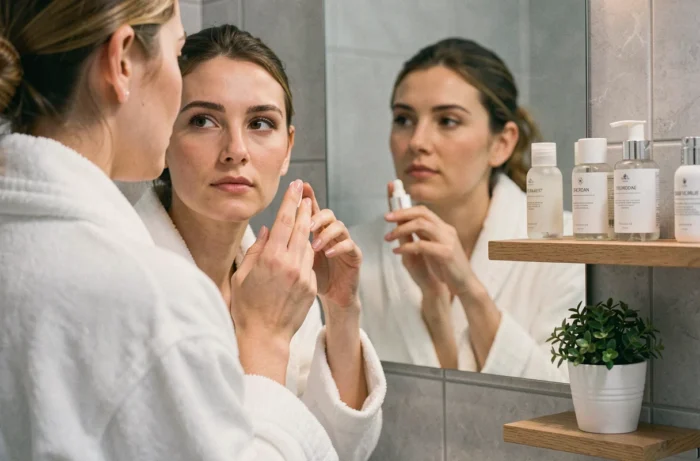
Taking care of your beauty every day doesn’t require a cupboard full of products or hours in front of the mirror. A few well-chosen steps, tailored to your skin type and lifestyle, are enough to keep your complexion fresh and your skin comfortable. The key is to understand what each step actually does and know which professionals can offer guidance when questions arise.
Allergens and cosmetic labels: what’s changing in Europe
Have you ever turned a bottle around to try to decipher the ingredient list on the back? This list, known as INCI, follows a regulated format in Europe. An update is underway, with a transition period before it is fully implemented. In practical terms, the same ingredient may appear under different names depending on when the product was made.
European Regulation 2023/1545 also expands the list of fragrance allergens that must be listed individually on packaging. For sensitive or reactive skin, this change makes it easier to identify substances to avoid. The disclosure thresholds vary depending on whether a product is rinsed off or left on the skin.
Two simple habits can help you make sense of it all. First, check the manufacturing date or batch number to find out which version of the nomenclature applies. Then, make a note of the INCI names of ingredients that cause reactions and compare them every time before you buy. To find beauty professionals who can advise you on these matters, the Annuaire Beauté beauty directory lists businesses by specialty and location.

Morning and evening skincare routine: the steps that really matter
Facial skin is constantly renewing itself. In the morning, it carries traces of the sebum produced overnight. By evening, it has accumulated pollution, makeup and dust. Cleansing twice a day is the foundation, but how you do it makes all the difference.
Morning cleansing
A gentle cleanser is all you need. The goal isn’t to strip the skin, but to remove the oily film left overnight without weakening the skin barrier. Lukewarm water gently opens the pores, while a cool rinse at the end refreshes the skin. Overly harsh cleansing has the opposite effect: the skin compensates by producing more sebum.
Double cleansing in the evening
In the evening, an oil-based product (oil or balm) first dissolves makeup and oil-soluble impurities. A water-based cleanser then removes any remaining residue. This two-step method avoids rubbing and helps limit irritation.
After cleansing comes hydration. A serum rich in active ingredients absorbs better on clean, slightly damp skin. Moisturizer seals everything in. Applying products from the lightest to the richest texture helps each one absorb properly.
Daily sun protection: more than just an anti-aging step
Sunscreen is often presented as a way to prevent wrinkles. French health authorities stress that its primary role is prevention. Their advice is clear: seek shade and wear covering clothing, then use sunscreen as an additional measure on exposed areas.
Reapplying during prolonged sun exposure remains essential, even when using a high SPF. The amount applied matters just as much as the SPF itself. Most people apply less than half the amount used in laboratory testing, which cuts the actual level of protection.
- Apply sunscreen as the last step in your morning routine, after moisturizer, so you don’t dilute its protection.
- Choosing a texture suited to your skin (a fluid for oily skin, a cream for dry skin) makes it easier to apply regularly.
- Check the expiration date: a product that has been open for more than a year may be less effective.

Salon treatments: choose ongoing care over one-off appointments
Salon appointments are evolving. The trend is shifting toward skincare programs spread over several sessions rather than one-off transformations. An initial skin assessment allows the esthetician to adapt treatments over time based on the results.
This approach offers a practical advantage. Dehydrated skin doesn’t respond the same way in January as it does in July. Adjusting textures, active ingredients and treatment frequency to the seasons delivers longer-lasting results than a single treatment, however effective it may be.
Choosing a salon that suits your needs
Not all salons offer the same specialties. Some focus on anti-aging treatments, while others specialize in acne or sensitive skin. Before booking, checking the practitioner’s training and the brands they use can give you a good idea of the salon’s focus.
- Ask for a skin assessment at your first appointment, even if it isn’t part of the standard service.
- Choose a salon that offers a treatment plan over several sessions rather than a menu of one-off services with no follow-up.
- Make a note of the products used during your treatment so you can compare them with your at-home routine.
Everyday beauty comes down to simple steps repeated consistently. Understand what each step does, read the labels on the products you apply to your skin, and seek guidance from qualified professionals for specialized treatments: these three pillars are all you need to build a routine that lasts, without buying unnecessary products.