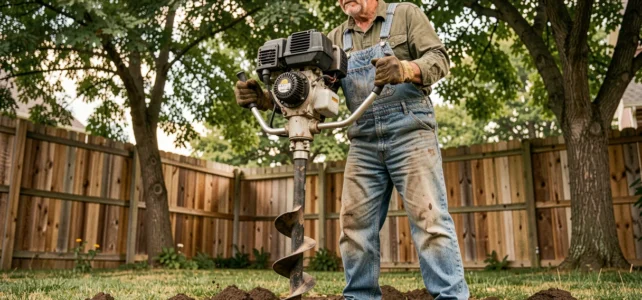
A gas auger does not tolerate approximation. The two-stroke engine provides enough torque to navigate through most soils, but the operator’s technique determines the outcome as much as the machine’s power. Before starting the drilling, several parameters deserve special attention: the nature of the terrain, the risk of buried networks, and the management of obstacles underground.
Buried networks and site preparation before drilling
Specialized content on gas augers extensively details the choice of bit or starting the engine. However, checking for buried networks is often addressed in just one line. Yet, this is the step that can turn a simple fence hole into a serious incident.
Related reading : Adopt a unique style with the best fashion tips for all seasons
Gas pipelines, electrical cables, water lines, fiber optics: depending on the area, several types of networks can run through a garden at shallow depths. In France, the DT-DICT system (work declaration and declaration of intent to commence work) requires project owners to consult network operators before any soil drilling. For an individual installing a fence, the process goes through the online tele-service.
Visual inspection of the terrain complements this administrative check. Before placing the bit on the ground, the work area must be cleared of any debris, exposed stones, or remnants of vegetation. Knowing how to dig a hole in the ground with a gas auger starts with this preparation phase, well before starting the engine.
See also : The best tips for quickly finding a job online in 2024
Clay or compact soil: the gradual disengagement technique
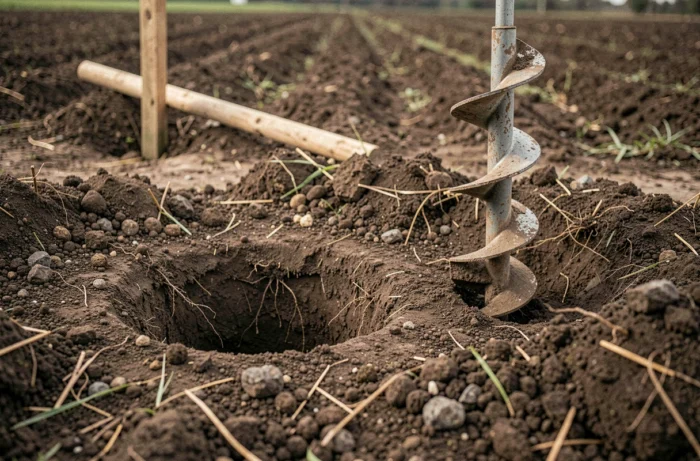
Not all soils are drilled in the same way. Loose, sandy soil allows the helical bit to descend almost without resistance. Clay, compacted, or stony soil presents a completely different behavior, and this is where most errors occur.
Forcing the descent in compact soil is the reflex to absolutely avoid. The bit gets stuck, the engine’s torque is transmitted to the handles, and the risk of kickback (sudden machine recoil) increases significantly. Recent technical guides recommend a gradual disengagement method:
- Push the bit down about twenty centimeters, then fully raise it to clear the debris accumulated along the helix.
- Repeat the operation in successive stages until reaching the desired depth, allowing the bit to rotate during the ascent to facilitate the ejection of soil.
- In case of contact with a thick root or stone, immediately cut the engine rather than insisting. Manually clear the obstacle before resuming drilling.
Wet clay poses a specific problem: it sticks to the bit and forms a plug that prevents the natural evacuation of debris. Some operators pour a little water into the hole to facilitate the ascent, but field feedback varies on the actual effectiveness of this practice depending on the density of the clay.
Adapting the bit diameter to the type of work
The choice of drilling diameter directly depends on the intended use. For a fence post, a moderately sized bit is generally sufficient. For planting a fruit tree, a larger diameter is necessary to allow space for the roots and filling substrate.
Increasing the diameter of the bit also increases soil resistance, and thus the demand on the engine and operator. In difficult terrain, it is sometimes better to create a pilot hole with a narrow bit, then widen it on a second pass.
Kickback and safety: what the bit brake does not guarantee
Kickback remains the main danger when using a gas auger. It occurs when the bit encounters a hard obstacle (rock, root, pipeline) and the engine’s torque is suddenly transmitted to the entire machine, which then spins in the operator’s hands.
Most recent gas augers incorporate a safety clutch that cuts off transmission in the event of a blockage. This device reduces the risk but does not eliminate it. The safety clutch does not protect against an obstacle encountered at full rotational speed.
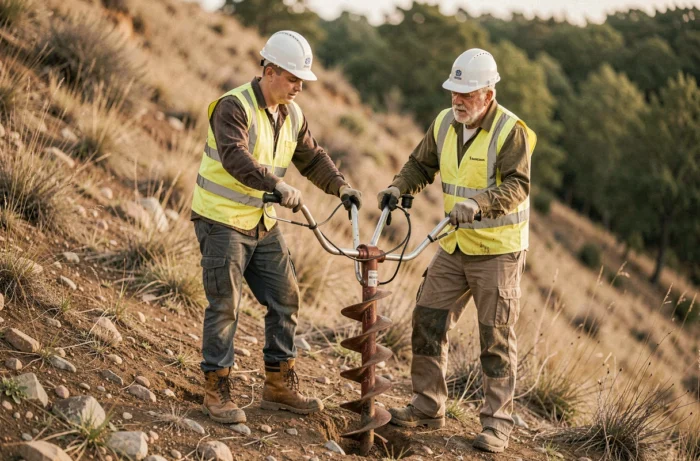
Several additional precautions limit exposure to kickback:
- Keep both hands on the handles throughout the drilling process, with a firm but not tense grip.
- Work at a moderate speed in the first few centimeters, while assessing the soil resistance.
- Wear anti-vibration gloves, safety shoes, and protective goggles. Soil and stone projections are common.
- On two-operator models, verbally coordinate before each start and stop.
An operator alone on an auger designed for two people faces a significantly higher risk of injury. The weight of the machine and the reaction force in the event of a blockage exceed what one person can reliably control.
Maintenance of the two-stroke engine and longevity of the bit
The engine of a gas auger operates with a gasoline-oil mixture whose ratio varies by manufacturer. A mixture that is too low in oil accelerates cylinder wear. A mixture that is too rich clogs the spark plug and reduces the power available for drilling.
After each work session, cleaning the helical bit extends its lifespan. Dried soil, especially clay, gradually corrodes the steel if it remains in prolonged contact. A wash with water followed by light lubrication is sufficient in most cases.
The air filter is the most exposed part when drilling in dry and dusty soil. Checking and cleaning it before each use prevents a gradual loss of power that many users mistakenly attribute to a carburetor problem.
The market is also evolving towards battery-powered augers for professionals, with arguments centered on noise reduction, absence of direct emissions, and lighter maintenance. For intensive work in difficult soil, the gas auger retains the advantage of engine torque, but the performance gap is narrowing for common garden and fencing uses.