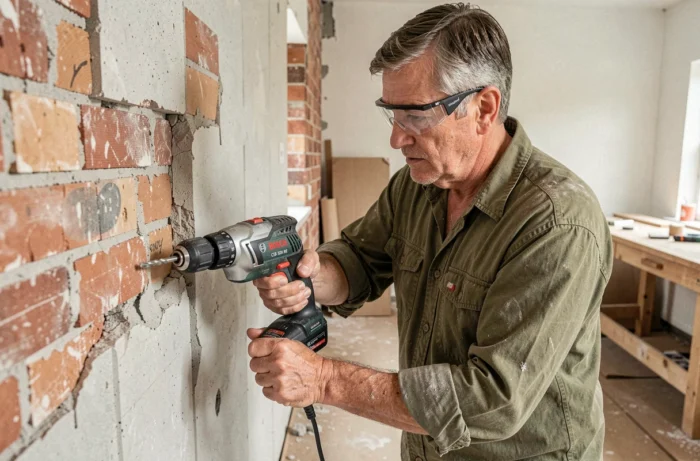
The Bosch CSB 500 RE (or PSB 500 RE depending on the markets) remains a reference corded percussion drill for common tasks. Its 500 W motor, automatic chuck, and electronic speed control make it a versatile tool, provided you master a few adjustments that the official manual barely touches upon.
Percussion selector and rotation speed: the duo not to be overlooked
The percussion mode switch on the CSB 500 RE is not just a simple on/off. Activating percussion on an unsuitable material accelerates wear on the mechanism and degrades the quality of the hole. We recommend reserving percussion for lightweight concrete, brick, and stone, systematically turning it off for wood, metal, and plastic.
The electronic speed control integrated into the trigger allows for real-time adjustment of the rotation speed. When drilling into steel, gradual pressure prevents overheating of the HSS drill bit. On hollow brick, a medium speed with percussion limits the chipping of the material at the exit of the hole.
To use the Bosch CSB 500 RE drill appropriately, this speed control should be considered a true precision tool, not just a simple variable switch.

Depth stop and auxiliary handle: often neglected adjustments
The depth stop is the most underutilized accessory of this drill. It fits into the additional handle via the locking button. With the groove facing up, you adjust the distance between the tip of the drill bit and the end of the rod to achieve the exact desired depth.
This adjustment becomes critical when installing anchors in thin partitions. Drilling too deep into a drywall partition can penetrate the board and render the anchor unusable. The depth stop eliminates this risk by mechanically stopping the advance.
The auxiliary handle, on the other hand, is not only for comfort. During percussion drilling in concrete, the reaction torque can cause the machine to rotate in your hands. Tightening the handle on the collar and positioning it opposite the force helps stabilize the tool and keep the drilling axis straight.
Reversing the rotation direction for unscrewing
The rotation direction switch is operated fully to the left for standard mode (drilling, screwing) and to the right for reverse. Never reverse the motor direction while running: wait for the chuck to come to a complete stop before flipping the switch to protect the internal mechanism.
The reverse function is useful when removing stubborn screws or freeing a drill bit stuck in hard material. For a bit stuck in concrete, a brief reverse impulse is usually enough to release it without forcing the chuck.
Automatic chuck of the CSB 500 RE: tightening and maintenance
The quick-clamping chuck accepts cylindrical shank bits. To insert a bit, hold the rear sleeve and turn the front sleeve counterclockwise until sufficiently open. After insertion, tightening is done in reverse, firmly but without tools.
A poorly tightened chuck causes runout, resulting in oval holes and premature wear of the drill bit. We regularly observe this problem on machines used without checking the tightening between two bit changes.
In terms of maintenance, the jaws of the chuck accumulate concrete dust and metal shavings. Periodic cleaning with compressed air, followed by a drop of lubricant on the clamping ring, keeps the mechanism running smoothly. Bosch spare parts catalogs list the chuck as a replaceable wear part, just like the motor brushes.
When to replace the motor brushes
The brushes are the main wear parts of a corded drill. Warning signs include:
- Progressive loss of power despite a proper connection and a sharpened bit, indicating that the brushes are no longer transmitting current effectively to the collector.
- Visible sparks at the ventilation slots, indicating irregular contact between the brush and collector.
- Intermittent motor stops during drilling, a symptom of brushes that have reached the end of their life.
Replacing the brushes on the CSB 500 RE is done through the side access panels provided by Bosch. This simple operation significantly extends the machine’s lifespan.

Matching the bit to the material: correspondence table
The choice of bit determines the result as much as the machine’s settings. Here are the combinations to follow on the CSB 500 RE:
| Material | Type of bit | Percussion | Speed |
|---|---|---|---|
| Wood | Wood bit (centering tip) | Disabled | High |
| Steel | HSS bit | Disabled | Moderate |
| Concrete / brick | Concrete bit (carbide) | Enabled | Medium to high |
| Tiles / ceramics | Pointed bit | Disabled | Low |
| Plastic | Wood or HSS bit | Disabled | Low to moderate |
On tiles, percussion must be strictly avoided: the mechanical shock cracks or shatters the ceramic. A pointed bit with water lubrication and a low speed provides a clean hole without breakage.
Electrical safety and European regulatory developments
The CSB 500 RE is a Class II tool (double insulated), exempt from grounding. However, this design requires regular checks of the power cable’s condition: any cut or crushing of the cord compromises protection and requires replacement.
Regarding regulations, the European regulation EU 2023/1230 will replace the old machinery directive on January 20, 2027. This development strengthens the obligations for traceability, safety information, and the presence of a responsible economic operator within the European Union for any tool placed on the market.
For current users of the CSB 500 RE, the impact is indirect but real: future manuals, CE markings, and compliance requirements will be stricter. Keeping the original documentation of your machine and proof of purchase remains a good practice in case of disputes or product recalls.
A 500 W corded percussion drill covers the vast majority of domestic and semi-professional needs. The difference between a clean hole and a failed one rarely lies with the machine itself, but almost always with the choice of bit, the mode setting, and the mastery of speed.