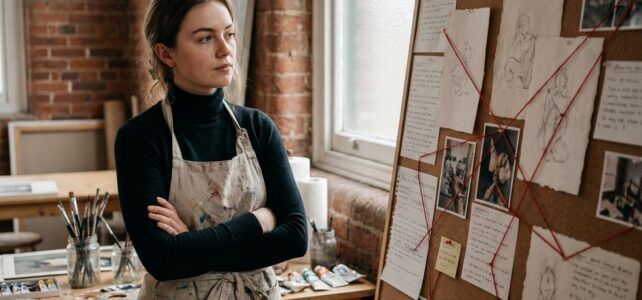
A high school graduate passionate about drawing hesitates between an art preparatory course, a DN MADE, and a private bachelor’s degree. Three months later, he enrolls in a bachelor’s degree in art history “in the meantime,” then shifts to a fashion school the following year. This type of zigzag trajectory costs time, money, and especially self-confidence.
The artistic path after high school offers many entry points, but it is the lack of a guiding thread that turns exploration into wandering.
See also : What is the price of a high-end 100 m2 pool and what options to choose?
Establish a guiding thread before choosing an artistic training
People often confuse “choosing a school” with “choosing a direction.” The first question to ask is not “preparatory course or DN MADE?” but “what type of production do I want to create in three years?”
A guiding thread is a work intention formulated simply. For example: “I want to design everyday objects in small series,” or “I want to tell stories through animated images.” It is not a specific job; it is a creative axis that directs concrete choices.
Recommended read : How to integrate Robthecoins and blockchain into a portfolio diversification strategy
Without this axis, one ends up stacking training programs that do not relate to each other. With it, each step (preparatory year, specialization, internship) feeds into the same project. This is what allows one to build a coherent artistic path rather than a series of isolated attempts.
To formulate this axis, one can start with a simple exercise: list the five personal works one is most proud of, then look for what they have in common (material, intention, format, target audience). The guiding thread is found in existing practice, not in a catalog of training programs.
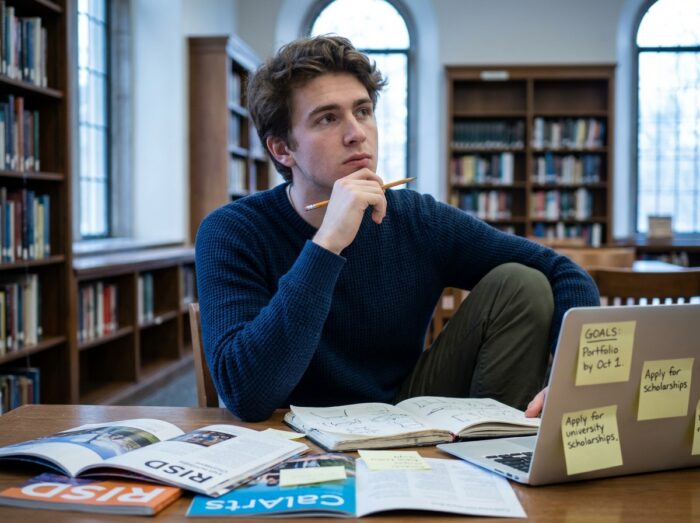
Art preparatory course, DN MADE, private bachelor: concrete selection criteria
The three main entry points after high school in art do not prepare for the same realities. Comparing them solely on the criteria of “level” or “prestige” leads directly to zigzagging.
What each path actually produces
- The artistic preparatory class (public or private) serves to build a solid portfolio of personal works and to prepare for entrance exams for higher art schools. It is not a degree-awarding program, but it structures the plastic research process in one year.
- The DN MADE (national diploma of crafts and design) trains for three years in a specific field of applied arts: graphic design, space, textiles, objects, digital. It grants a bachelor’s degree and facilitates quick integration into a workshop or studio.
- Private bachelor’s programs (three to five years) often offer hybrid curricula combining technical courses, internships, and professional mode projects. Their quality varies significantly from one institution to another, and feedback on this point varies according to the cohorts and chosen specializations.
The real selection criterion
One saves time by asking a direct question: do I want to create within a structure (agency, house, studio) or develop an authorial practice? The first orientation pushes towards the DN MADE or a design-oriented bachelor. The second often requires a preparatory course followed by a higher art school.
Choosing the training that corresponds to one’s working style avoids reorientation along the way.
Artisan crafts after high school: an underestimated guiding thread
Most post-high school artistic orientation guides focus on art and design schools. A third path that is gaining structure is artisan crafts.
The national diploma of artisan crafts, created by decree 2026-88 of February 13, 2026, offers a certification framework for profiles who want to articulate technical gesture, creation, and economic integration. This diploma constitutes a clear path without going through general art schools.
For a graduate attracted to ceramics, marquetry, bookbinding, or stained glass, this path presents a clear guiding thread: mastering a material skill and transforming it into a creative activity. It includes courses in drawing, art history, and specific techniques, but oriented towards the concrete production of objects.
Artisan crafts also allow for the integration of digital tools in the upstream phase of the project (modeling, visual testing, computer-aided prototyping) without renouncing handwork. This hybridization between physical workshops and digital pre-production corresponds to a strong trend in the creative sector.

Building your personal artistic portfolio: the backbone of the journey
Regardless of the targeted curriculum, the personal works portfolio remains the document that proves the coherence of a path. Admission juries for art schools or DN MADE do not seek technical perfection: they look for a perspective, an obsession, a consistency.
What makes a difference in a portfolio
A good portfolio does not show “everything I can do.” It shows how one thinks. Three series of works around the same questioning are worth more than twenty disparate pieces.
Concretely, this means keeping a record of one’s research: sketchbooks, process photos, written notes, screenshots of references. The artistic portfolio documents a process, not a collection of results.
- Select a maximum of fifteen works that relate to each other rather than seeking exhaustiveness.
- Include personal projects completed outside the school framework: they demonstrate autonomy and commitment.
- Present at least one project that failed or diverged, explaining what was learned from it. Juries immediately spot portfolios that are too polished.
When to start building
As early as possible, ideally from the first year of high school. Waiting until the final year to gather works condemns one to a superficial portfolio. A solid portfolio is built over two years of regular practice.
Municipal workshops, evening classes in art schools, and workshops open to high school students allow one to enrich their practice without waiting to enter higher education. These experiences directly feed into the guiding thread of the journey.
The artistic path after high school does not need to be linear to be coherent. What matters is being able to explain each step by linking it to a personal work axis. An assumed and documented reorientation is better than a “clean” curriculum followed by default. The guiding thread is not decided once and for all: it is refined with each project, each encounter, each piece added to the portfolio.