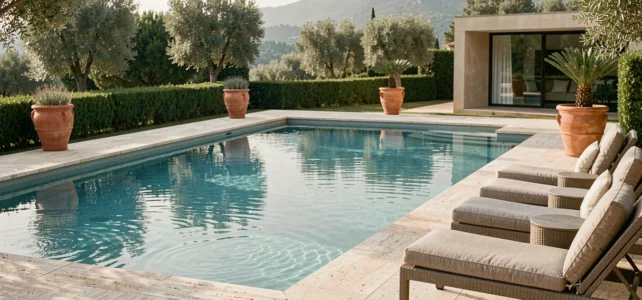
A custom 100 m² reinforced concrete pool is not budgeted like a standard enlarged basin. Transitioning to this size imposes structural, hydraulic, and regulatory constraints that significantly widen the gap between the quoted estimate and the final bill. Here, we detail the technical aspects that distinguish a high-end project from a simple pool enlargement.
Invisible costs of a 100 m² pool: earthworks, structure, and hydraulics
For a pool of this size, earthworks represent a much heavier item than for a pool measuring 8 x 4 m. The volume of excavation increases non-linearly: more soil needs to be removed, longer walls must be stabilized, and often the banks need to be reinforced with temporary support. A clayey soil or a high water table requires peripheral drainage and sometimes a waterproofing system, two items often absent from most initial quotes.
See also : How to Choose the Ideal Dimensions for a Pool Without Paying Taxes?
The reinforced concrete structure requires enhanced rebar as soon as the length exceeds about ten meters. The slabs must be sized to withstand hydrostatic pressure over a surface that multiplies the constraints compared to a standard pool. We recommend a structural calculation by an independent engineering firm, as pool builders rarely include this item in their standard estimates.
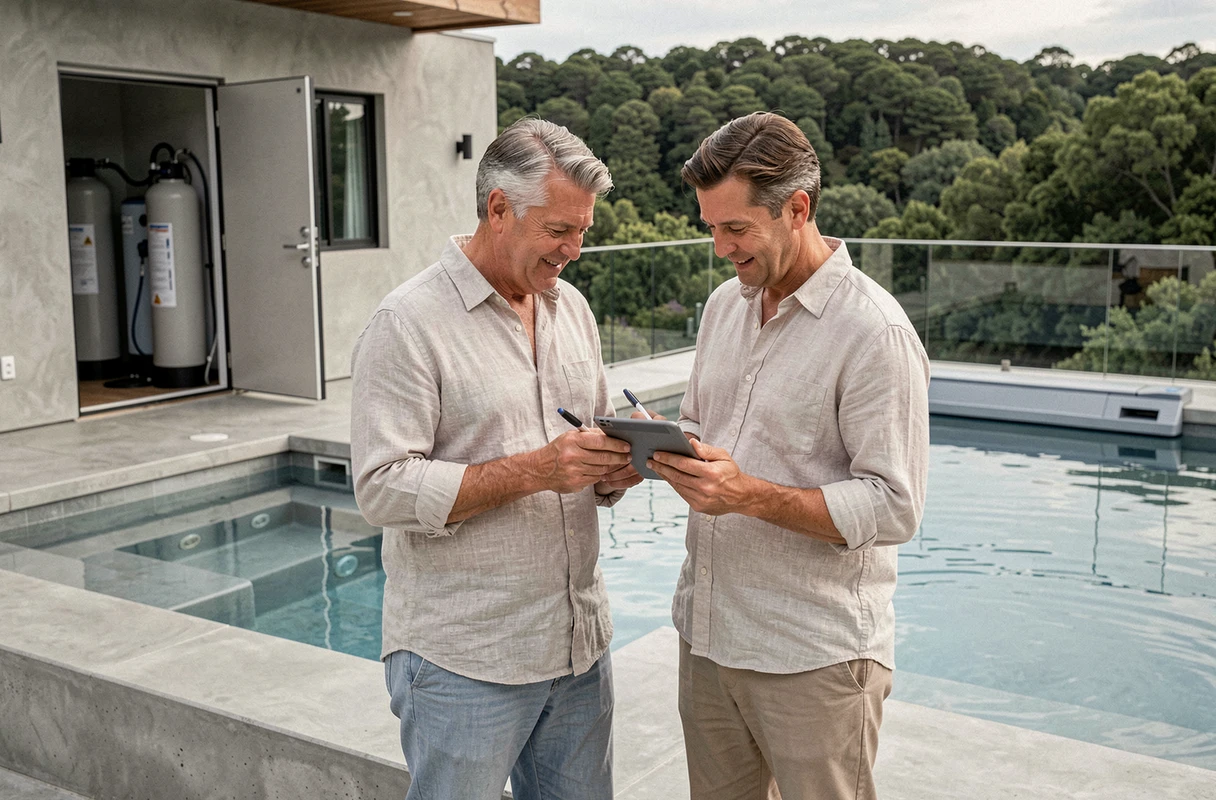
On the hydraulic side, a water volume of this magnitude requires an oversized return network, several skimmers, or a peripheral gutter, and a filtration system whose flow rate far exceeds that of typical residential equipment. The technical room resembles that of a semi-collective pool.
See also : Tips and Advice to Preserve the Shine of Your Plant-Based Jewelry
To better understand the price of a high-end 100 m² pool, one must add these structural items to the cost of the bare basin, which often doubles the initial estimate.
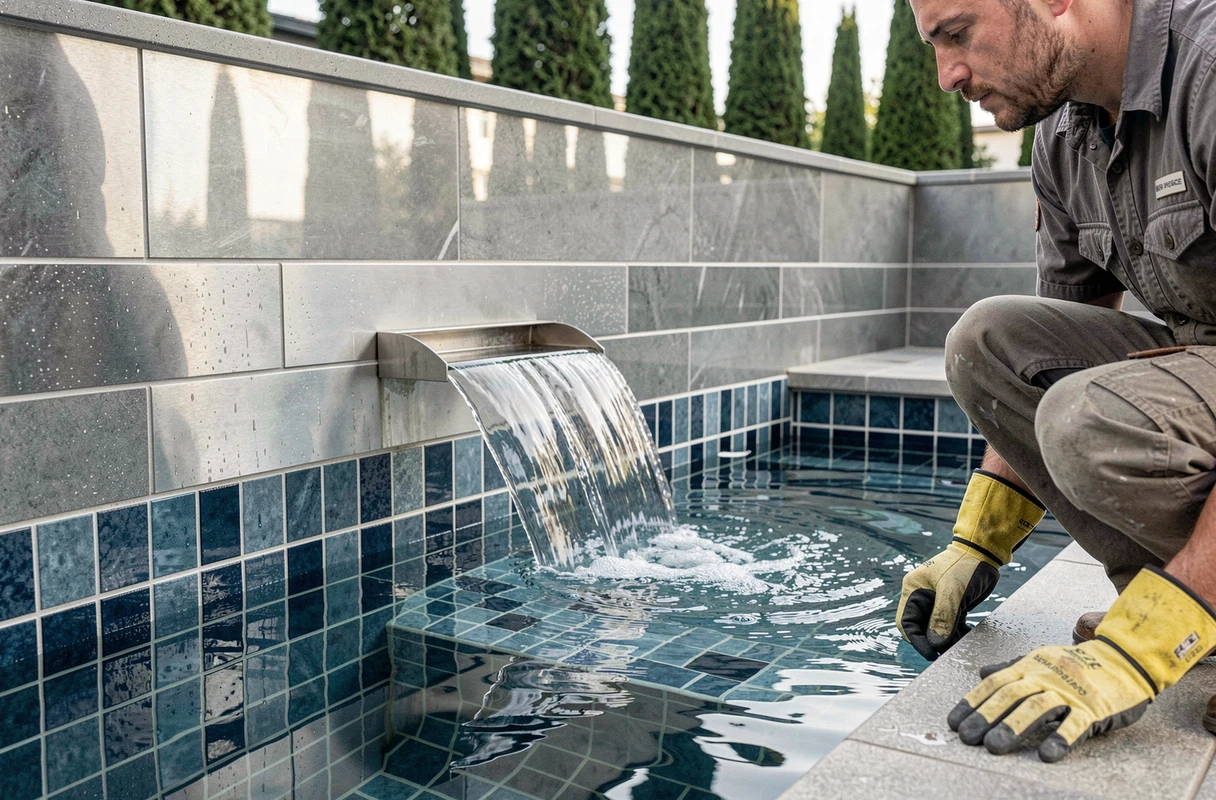
Concrete block or shotcrete for a high-end pool: which method to choose
At 100 m², the polyester shell is automatically excluded. Manufacturers do not offer molds at this size, and transporting a monobloc piece of this size would be logistically unrealistic. The choice is therefore limited to concrete, but two techniques are in opposition.
Shotcrete (gunite or shotcrete) allows for total freedom of shape. It is suitable for organic designs, progressive bottoms, and complex architectural integrations. However, the quality of the result heavily depends on the applicator’s skill. An uneven thickness or insufficient compaction can lead to cracks in the medium term.
Formed reinforced concrete remains the reference for large geometric pools. It offers superior dimensional control and homogeneous structural strength. Its cost is more predictable, but the implementation is slower, and curved shapes are difficult to achieve.
In both cases, the final coating affects the budget: a waxed finish, ceramic tiling, or a glass mosaic do not have the same financial impact at all. The high-end mosaic can represent a quarter of the total budget for a 100 m² pool.
Premium options that change the budget of a luxury pool
Not all options carry the same financial weight. Here, we classify those that truly shift a project into the luxury segment, beyond just careful finishing.
- Peripheral or mirror overflow: the system requires a buffer tank sized for the water blade volume, a dedicated pump, and additional earthworks. The structural cost far exceeds that of an overflow on just one side.
- Integrated spa with separate hydraulic circuit: the spa area requires its own jets, heater, and filtration. Integration into the main pool complicates waterproofing at the junction of the two basins.
- Complete automation (treatment, cover, lighting, heating): a centralized management system controls everything via a home automation interface. The wiring and programming add a line item that is often underestimated.
- Motorized submerged cover: for 100 m², the guide rails and winding mechanism must support a considerable weight of slats. The reception pit at the end of the pool extends the footprint.
Safety and regulations for a large in-ground pool
French regulations require at least one of the four standardized safety devices (barrier, alarm, cover, shelter). For a 100 m² pool, some solutions become technically unsuitable. A standard submerged alarm struggles to cover such a large body of water without false alerts. The perimeter barrier or shelter remains the most reliable solutions at this scale.
A telescopic or fixed shelter for 100 m² constitutes a project within a project: dedicated foundations, ground rails, and sufficient height under the structure. A building permit is systematically required for a shelter of this footprint.
Taxation and declaration
Any in-ground pool over 10 m² is subject to prior declaration or building permit depending on the area and the potential presence of a shelter. Property tax and development tax increase in proportion to the pool’s surface area. For 100 m², these annual amounts are no longer negligible and must be included in the cost of ownership calculation.
Maintenance and operating costs of a 100 m² pool
The water volume of a pool of this size imposes a consumption of treatment products, energy expenditure for filtration, and heating costs that are significantly higher than those of a standard family pool. The energy item can represent several thousand euros per year if the pool is heated and used over a long season.
We observe that owners systematically underestimate the cost of water renewal (health regulations), wear of hydraulic equipment, and periodic replacement of the filter media. For a high-end pool, planning an annual maintenance contract with a specialized professional prevents silent degradations that ultimately cost much more than regular monitoring.
The true price of a high-end 100 m² pool is not reflected in a single quote. It is calculated by adding civil engineering, structural options, regulatory compliance, and operating costs over ten years. A realistic budget for this type of project starts in the high range of the luxury segment, from 80,000 to 100,000 euros for the equipped basin, before landscaping and external works.