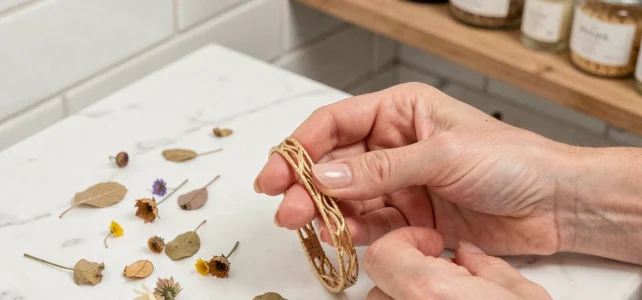
A capim dourado bracelet worn in the rain during a hike, a forgotten plant gold ring near the sink: these situations are enough to dull golden plant fibers in just a few hours. Plant gold is not a metal; it is a lignocellulosic material that reacts to water, sweat, and cosmetics in a radically different way than classic gold. Preserving the shine of your plant gold jewelry involves precise actions tailored to this natural fiber.
Plant fibers and humidity: why plant gold degrades differently than classic gold
Jewelry care is often associated with classic recipes (soapy water, baking soda). With plant gold, these reflexes can do more harm than good. Lignocellulosic plant fibers are hygroscopic: they absorb ambient moisture, swell, and then contract as they dry.
See also : How to Forward Mail by Crossing Out the Address: Tips and Practical Advice
This swelling-contraction cycle weakens the internal structure of the jewelry. A review published in 2025 in the journal Polymers confirms that moisture absorption can lead to a significant decrease in mechanical strength in natural fiber composites. Specifically, a plant gold bracelet regularly exposed to water loses its rigidity, its fibers detach, and its golden surface becomes dull.
Here you can find tips for maintaining plant gold that emphasize this point: prolonged contact with water is the main enemy of these pieces, much more than dust or friction.
Related reading : Discover the latest beauty trends and tips to enhance your daily life
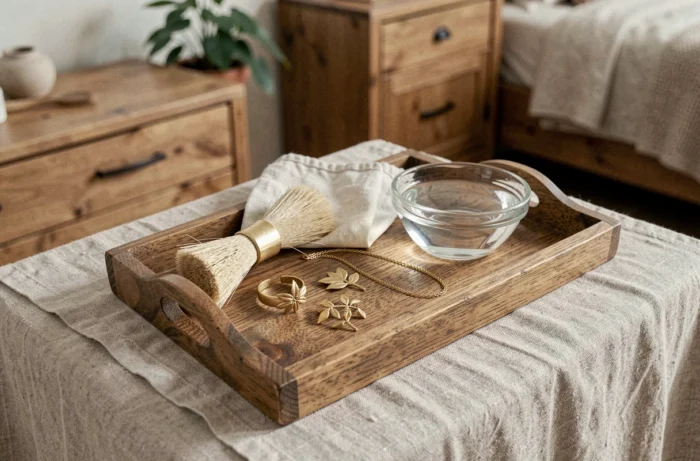
Recovering plant gold jewelry after accidental contact with water
We’ve all forgotten a piece of jewelry on our wrist before doing the dishes. When this happens with plant gold, there is a documented recovery procedure by artisans specializing in biobijoux.
- Gently rinse the jewelry with a neutral soap to remove residues of chemicals or limescale, without rubbing the fibers
- Expose the jewelry to sunlight for about three hours so that the fibers dry completely and regain their natural shine
- Then store it in a dry place, away from any source of residual moisture
This method, recommended by the Bioferta/Sloweco shop on its biobijoux product sheets for capim dourado, works provided the jewelry hasn’t soaked for too long. If the fibers have already started to detach or whiten, the recovery will be partial. Results vary on this point depending on the thickness of the fibers and the type of setting used.
Gentle cleaning of plant gold: actions that preserve shine
Regular cleaning of plant gold jewelry does not require special products, but it excludes anything abrasive or chemical. Forget about paste baking soda, toothpaste, white vinegar—these are effective recipes on metal but disastrous on natural fibers.
The dry cloth method
A soft, dry cloth (microfiber or cotton) is enough to remove dust and fingerprints after each use. Wipe the cloth in the direction of the fibers, without pressing. This action takes a few seconds and prevents the accumulation of residues that dull the golden surface.
Neutral soap as a last resort
If the jewelry has a visible stain (makeup, sunscreen), lightly dampen a corner of the cloth with warm water and a drop of neutral soap. Dab the area without immersing the jewelry. Dry immediately in the open air or in the sun. Never soak plant gold jewelry in soapy water, even for a few minutes.
Storing plant gold jewelry: avoiding common mistakes
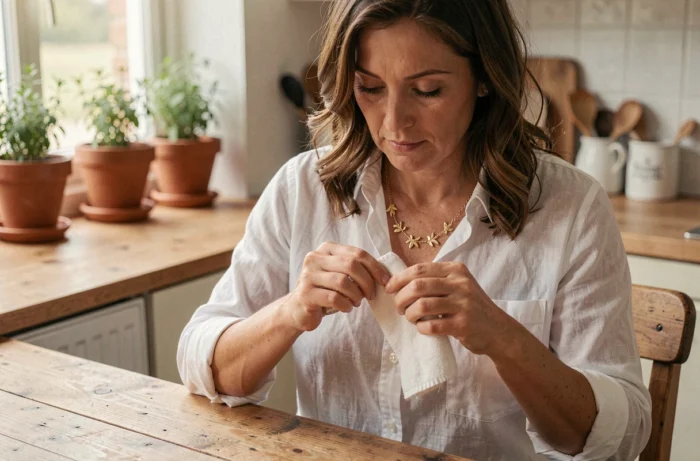
Storage is just as important as cleaning. Many pieces of plant gold lose their shine not because they are worn improperly, but because they are stored improperly.
- Avoid airtight plastic boxes that trap residual moisture, especially in summer or in a bathroom
- Prefer a breathable fabric pouch (cotton, linen) stored in a dry drawer
- Separate each piece of jewelry to avoid friction between items, as plant fibers fray faster than metal
- Never store your plant gold jewelry near a humid heat source (bathroom radiator, kitchen window)
A often overlooked detail: perfume. Sprayed directly on plant gold jewelry, the alcohol in perfume attacks the fibers and leaves irreversible stains. Apply perfume to the skin, wait for it to dry, then put on the jewelry.
Products and actions to absolutely avoid on plant gold
Grandma’s tips for classic gold are everywhere, and that’s precisely the problem. Applied to plant gold, some can destroy the jewelry in a single use.
A toothbrush, even soft, pulls out plant fibers. Baking soda is too abrasive for this material. Commercial jewelry cleaning products, formulated for metals, contain chemical agents incompatible with natural fibers. White vinegar, acidic, discolors the golden surface.
A piece of plant gold jewelry should be cleaned dry or with a minimum of water and a neutral soap, without exception. Any other method shortens its lifespan.
The most protective action remains the simplest: remove your plant gold jewelry before any activity involving water, cosmetics, or intense sweating. This daily reflex does more to preserve shine than any maintenance product.