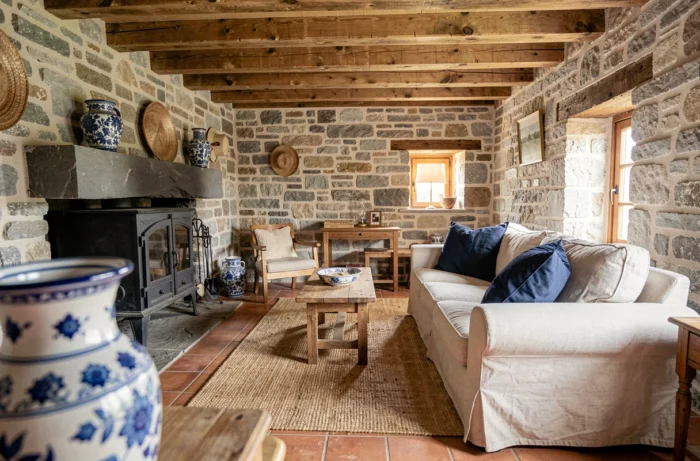
A Breton house, whether made of pink granite near Ploumanac’h or schist in central Finistère, imposes its rules before any desire for decoration. Humidity, old woodwork, and often insufficient insulation: one does not choose wallpaper or solid wood furniture without first addressing these issues. Arranging and decorating a house in Brittany is primarily about working with a climate and a structure that do not forgive improvisation.
Humidity and ventilation: the invisible work before decoration
It is common to see owners applying a decorative coating on a stone wall that has never been treated against rising damp. The result, a few months later: blistering, mold behind the TV cabinet, persistent odors in the room. In Brittany, dealing with humidity comes before any aesthetic choice.
The VMC (controlled mechanical ventilation) is the first investment to consider. In old houses, the absence of mechanical ventilation combined with thick stone walls creates a condensation effect that simple airing through windows cannot resolve. A humidity diagnosis carried out by a local professional helps distinguish rising damp (common on the ground floor) from condensation due to poor ventilation.
One can then consider breathable lime-based coatings, compatible with stone walls and the character of the Breton house, rather than plasterboard that traps moisture. To discover the house on Web de Bretagne, there are resources that guide towards artisans and solutions adapted to the regional building.
Energy renovation in Brittany: what concretely changes the finishes
Since January 1, 2025, homes classified G in the energy performance diagnosis (DPE) can no longer be rented. Homes classified F will follow in 2028. For Breton homeowners considering renovating a longhouse or a town house, the sequence of work is dictated by this regulatory constraint.
First, insulation is done, then decoration. The choice of insulation material (wood wool, cellulose wadding, expanded cork) directly influences the thickness of the interior walls and thus the layout of the rooms. Interior insulation can significantly reduce the usable area of a narrow room, which changes the arrangement of furniture and sometimes the choice of colors (light shades to compensate for the loss of volume).
Windows and natural light: a design as much as an energy decision
Old Breton houses often have small openings. Replacing single-glazed windows will still be financed in 2026 through the zero-interest eco-loan and the 5.5% VAT under certain conditions, even though the MaPrimeRénov’ “by gesture” pathway has been refocused since September 2026 on other operations.
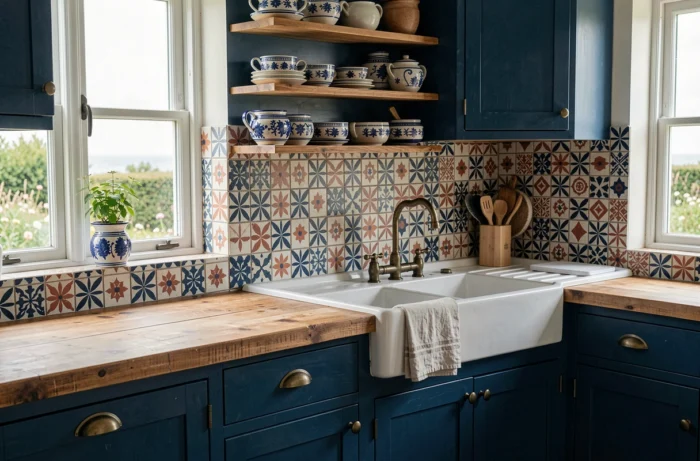
Choosing windows with thin frames increases the light intake without changing the size of the opening. In painted wood (off-white, slate gray, navy blue), they become a decorative element in their own right, coherent with the granite or light-coated facades typical of the region.
Materials and furniture: what works in a Breton house
Wood is omnipresent in Breton interior decoration, but not all woods react the same way to residual humidity. Local or climate-adapted species are preferred:
- Oak, dense and durable, is suitable for exposed beams, flooring, and solid furniture. It ages well over time and withstands hygrometric variations.
- Chestnut, traditionally used in Brittany for frameworks and flooring, offers a warm hue and good natural resistance to fungi.
- Treated maritime pine, less expensive, works for paneling and attic fittings, provided it is properly ventilated.
For furniture, traditional Breton furniture (wardrobe, dresser, closed bed) pairs well with a contemporary interior as long as it is not over-accumulated. A single antique piece in a room with light walls creates a focal point. Three antique pieces in the same room give a museum effect.
Textiles and colors suited to the climate
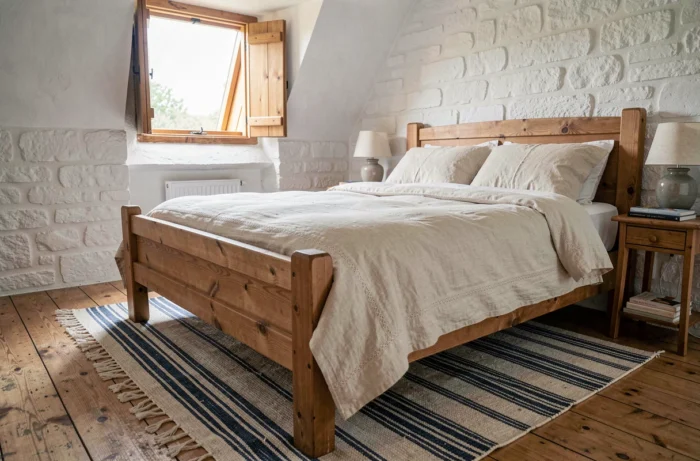
Thick fabrics (washed linen, felted wool, brushed cotton) provide thermal and visual comfort in living spaces. The colors that work best in a Breton house play on the contrast between the variable brightness of the outside and the warmth sought inside.
- Deep blues (navy blue, petroleum blue) evoke the ocean without falling into the beach cliché, especially when paired with raw wood.
- Off-whites and warm grays reflect light in rooms with small openings.
- Terracotta or ochre shades, less expected in Brittany, bring warmth that compensates for gray days, especially in north-facing rooms.
- Sage green, discreet, naturally harmonizes with exposed stone and woodwork.
Brittany outdoor arrangement: protect as much as decorate
A garden or terrace in Brittany endures wind, rain, and sea spray (on the coast). Outdoor materials must be chosen for their durability before their aesthetics. Composite wood or ceramic stoneware withstands Brittany’s weather better than exotic wood, which quickly grays without regular maintenance.
Dry stone walls, typical of the Breton landscape, serve both as windbreaks and plant boundaries. Rather than installing a standard fence, one can extend an existing wall with local stones recovered from demolition sites, maintaining visual coherence with the surrounding buildings.
Garden sheds made of treated wood, with a slate or anthracite gray steel roof, blend discreetly into the landscape. Opinions vary on untreated raw wood cladding: some appreciate the natural graying that harmonizes with the environment, while others find it neglected after two or three years.
Arranging a house in Brittany requires following a sequence: addressing structural and energy issues, then choosing materials compatible with the climate, and finally adding decorative elements. A successful Breton interior depends as much on the quality of insulation as on the choice of furniture. The two go hand in hand, and in that order.