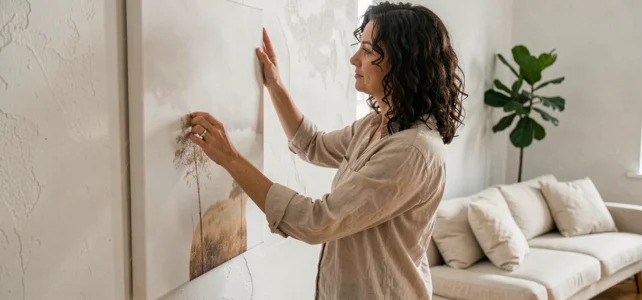
Customized wall decoration is not just about hanging a frame above the sofa. The wall supporting a decor project functions as a technical surface: its coating, load capacity, light exposure, and reversibility condition the choice of supports long before any aesthetic consideration.
Wall decoration without drilling: technical constraints and reliable solutions
A tenant or a condominium owner faces a simple rule: no holes, no marks, no damage to the surface. This constraint immediately rules out traditional plugs, screws, and nails. Alternatives exist, but their effectiveness depends on the type of wall.
See also : How to Choose the Best Site to Plan and Organize Your Next Trip
On a well-painted wall, repositionable adhesive strips (like Command 3M) can support loads ranging from a few hundred grams to several kilos depending on the model. We recommend checking compatibility with the finish: a matte paint adheres better than a satin finish, and a rough plaster reduces the contact surface to the point of making adhesion unpredictable.
On wallpaper, caution is required. Removing an adhesive can tear the top layer. Self-adhesive aluminum picture rails offer better weight distribution and peel off more cleanly, provided the glue is heated with a hairdryer before removal.
See also : How to Organize an Unforgettable Honeymoon and Choose Your Guests Wisely
For heavy items (decorative mirrors, lightweight wall shelves), adhesive rails or magnetic suspension systems are more robust options. Workshops like Imagin’Air Déco also offer creations designed for this type of drilling-free installation, suitable for evolving interiors.
- Repositionable strips: ideal for photo frames, lightweight posters, and small paintings on smooth walls
- Adhesive picture rails: suitable for modular compositions, allowing artworks to be moved without re-sticking
- Structural adhesive hooks: for medium loads on smooth surfaces, clean removal with heat
- Decorative washi tape: a temporary solution for fixing lightweight prints, zero residue on painted walls
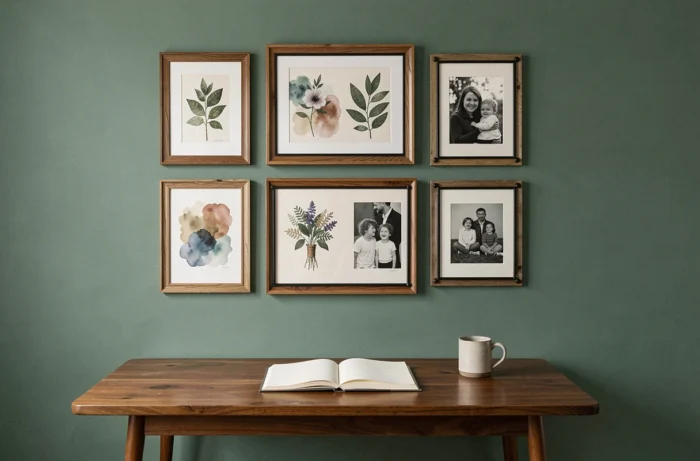
Wall composition: organizing a gallery wall that lasts
The current trend favors focusing on a single focal wall rather than spreading across all surfaces. We observe that this approach works better in smaller spaces: it structures the gaze instead of tiring it.
A successful gallery wall mixes formats and mediums. Personal photos, art posters, small mirrors, a narrow shelf with an object placed on it: this hybridization creates visual depth. Strictly symmetrical compositions (perfect grid of identical frames) yield a clean but static result, difficult to evolve.
Error-free setup method
Before fixing anything, we recommend cutting templates from kraft paper to the exact dimensions of each element. Attach them to the wall with masking tape. Live with this life-size mock-up for two or three days.
This step reveals balance, proportion, and visual flow issues that are not perceived in a sketch. Adjust the spacing: a regular interval of a few centimeters between each piece provides a coherent reading without a feeling of suffocation.
Wall lighting: transforming a decorative object into an ambiance element
A painting without light remains a flat rectangle. Recent guides emphasize this point: the lighting setup radically changes the perception of wall decoration. An adjustable wall sconce above a poster creates a visual hierarchy that a ceiling light alone does not produce.
Adhesive LED strips, placed behind a frame or under a shelf, generate a soft backlight that adds relief to the wall. In rentals, these strips can be removed without damage if a repositionable adhesive-backed model is chosen.
Clip-on spotlights, powered by USB cable, represent an alternative without electrical installation. They attach to the edge of a shelf or high furniture and project a beam directed at the artwork. The effect of cast shadows adds a sculptural dimension to a simple framed poster.
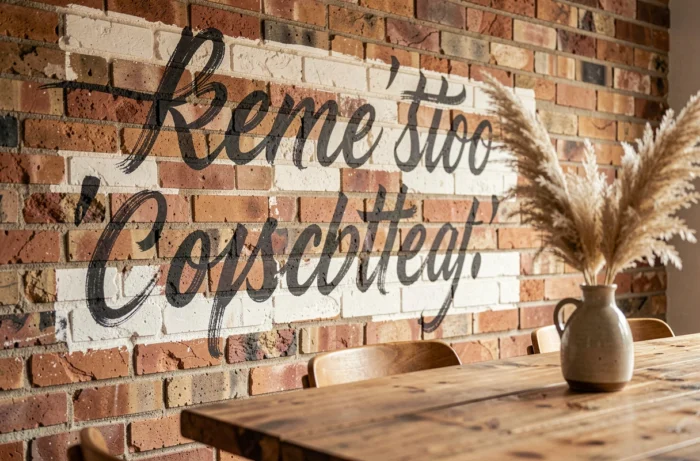
Custom materials and supports: beyond the classic frame
Wooden frames remain a classic, but customized wall decoration is no longer limited to that. Prints on brushed aluminum, plexiglass, or stretched canvas offer very different results depending on the type of image.
A landscape photo gains depth on aluminum support, whose reflective surface amplifies contrasts. A portrait or graphic illustration looks better on canvas, which absorbs light and softens details. The triptych (an image cut into three panels) creates a visual continuity effect suitable for large living room or dining room walls.
Decorative acoustic panels combine function and aesthetics. Covered with printed fabric, they reduce sound reverberation in a room while dressing the wall. These panels are fixed with clips or industrial velcro, making them perfectly compatible with a reversible installation.
Wallpaper scraps and wall patchwork
Wallpaper scraps, often underutilized, allow for creating original compositions at a lower cost. Framed in mismatched frames or glued in patchwork on a removable panel, they bring color and pattern without committing to an entire wall.
This technique works particularly well in a hallway or entryway, where a narrow wall can support dense patterns without saturating the space.
The choice of a custom wall support ultimately depends on three parameters: the type of wall, the expected duration of installation, and the available light in the targeted area. A well-lit wall forgives matte supports. A dark wall requires surfaces that capture or reflect light to exist visually. Adapting the support to these conditions produces a more refined result than any purely decorative choice.