
Crossing out the address on an envelope received by mistake and putting it back in a street mailbox seems to be the simplest gesture in the world. This common practice is based on a specific postal principle: to inform the mail carrier that the mentioned recipient no longer resides at that address, so that the mail can be redirected or returned to the sender.
Barcodes and automated sorting: why crossing out the address isn’t always enough
Modern postal sorting centers do not prioritize reading handwritten notes. Machines first scan the barcodes and QR codes printed on the envelope, which contain the delivery address encoded digitally.
Recommended read : Tips and steps to extend the shared child education benefit with the CAF
Crossing out the visible address with ink without touching these technical elements creates a conflict: the human operator sees the strike-through, but the automated system still reads the old address. The mail can then loop back to the same mailbox.
To avoid this trap, several postal operators now recommend completely blacking out the barcodes and QR codes present on the envelope, in addition to crossing out the address. A thick black marker covering these areas is enough to force manual processing of the mail, allowing the mail carrier to read the note “No longer lives at the indicated address” or “Return to sender.”
Related reading : Tips and Advice to Preserve the Shine of Your Plant-Based Jewelry
Knowing how to redirect mail by crossing out the address correctly requires a bit more than just a simple line through the recipient’s name.
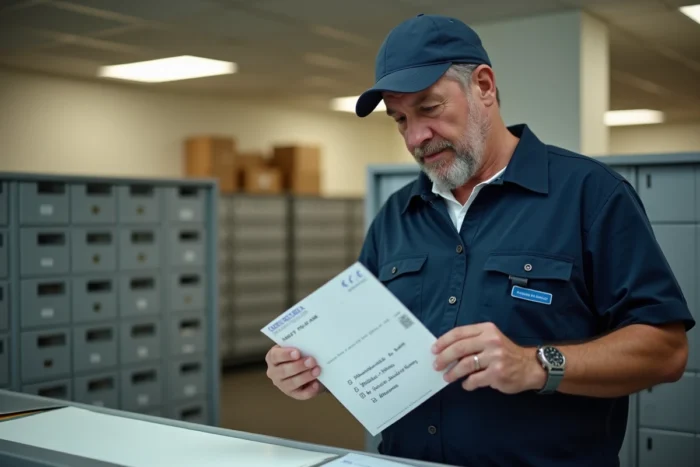
Handwritten note on the mail: what wording to use
The wording you write on the envelope determines what the mail carrier will do with the mail. Two scenarios arise, and the appropriate note is not the same.
Mail for a former occupant
If the mail is addressed to a person who no longer lives at your address, the clearest note remains “No longer lives at the indicated address” (sometimes abbreviated as NPAI in postal jargon). Cross out the entire address of the recipient and write this note clearly above or beside it.
You can also place a label on your mailbox with only your name. This precaution gradually reduces the volume of misdelivered mail, as regular mail carriers memorize the names of residents on their route.
Mail received by mistake in your name
If the envelope bears your name but concerns a delivery you did not request or that should go elsewhere, the note “Return to sender” is more appropriate. It instructs the postal service to return the mail to the shipping address on the back of the envelope.
- Cross out the entire address of the recipient (not just the name) with a clear and visible line
- Black out any barcodes and QR codes with a thick marker
- Write the chosen note in capital letters, preferably with a red or black marker
- Return the unopened mail to a street mailbox, without slipping it into your own mailbox
Redirecting mail with a new address: what works and what doesn’t
Some people wish to go further than simply returning to sender. The reflex is to cross out the old address, write the new recipient’s address, and put the mail back into circulation.
This method poses a concrete problem: the original postage has already been used. Postal operators consider that reusing the same stamp for a new delivery amounts to a new service. The mail may therefore be refused or charged separately during sorting.
In practice, some pieces of mail still go through, especially when sorting is manual. There is no guarantee of effective delivery. For mail where delivery matters (bills, administrative documents, medical mail), this makeshift method is not reliable.
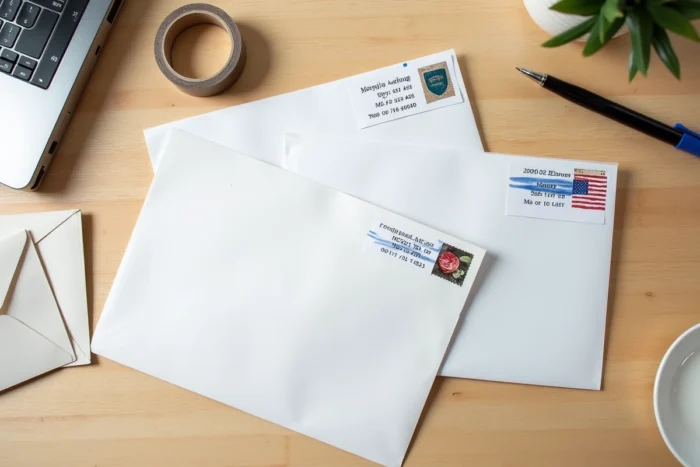
Registered mail and legal effects of return
The case of registered letters deserves special attention. An unclaimed or returned registered letter does not have the same legal consequences depending on the area concerned.
In administrative matters, a registered letter “notified and unclaimed” can serve as a regular notification: the recipient is considered informed even if they have not collected the mail. In the case of a residential lease, an unclaimed registered letter does not always produce this effect and may require notification by another means.
Crossing out the address and returning a registered letter to the postal system is therefore not trivial. If you receive a registered letter intended for a former occupant, the safest course is to refuse delivery from the mail carrier or to let the mail naturally return to the sender via the post office, without any intervention on your part on the envelope.
Postal forwarding service: the alternative to the manual gesture
Crossing out the address on each piece of mail received by mistake works for a few isolated pieces. When the volume becomes regular (after a move, a death, or a changing roommate situation), the structural solution remains the definitive forwarding service from La Poste.
This service, subscribed to by the person moving (or their heirs), automatically redirects all mail to the new address for a specified period. The automated sorting is then updated in advance, without manual intervention on the envelopes.
If the former occupant has not subscribed to this service and mail continues to arrive, a procedure with the local administration or directly at the local post office can sometimes signal the situation. The mail carrier can then be informed not to deliver mail addressed to that person.
The act of crossing out the address remains a useful stopgap in daily life, provided that the barcodes are also neutralized and the correct note is chosen. For any mail with legal implications, it is better not to intervene on the envelope and let the official postal system take its course.