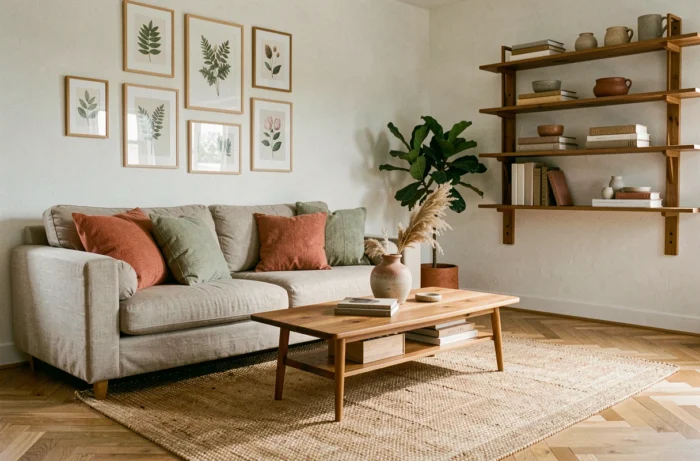
Home decoration is no longer limited to choosing a wall color or a sofa. The second-hand furniture market is becoming more structured, environmental constraints weigh on available materials, and trends are changing at a pace that makes it difficult to maintain choices over time. Here are ten concrete ideas to transform your interior starting from what you already have at home, without necessarily going through a heavy renovation.
1. Lime plaster wall in the living room
Lime applied directly to an existing wall creates an irregular mineral effect that neither matte paint nor wallpaper can reproduce. The texture varies depending on the number of layers and the grain size of the sand used.
This type of finish works particularly well in a living room or entryway where natural light hits the wall at an angle. Lime plaster regulates ambient humidity, making it a technical as well as aesthetic choice in poorly ventilated rooms. The cost remains moderate if you do the application yourself, but the technique requires a steady hand to avoid marks from touch-ups.
Specialized catalogs like that of reves-de-deco.fr allow you to visualize combinations of textured plasters and contemporary furniture before getting started.
2. Reuse of furniture through the REP furniture sector
Thrifting is no longer the only option for furnishing differently. The REP furniture sector now structures the reuse of furniture with reinforced objectives in the 2024-2029 specifications. In 2025, Ecomaison reported supporting 155 projects and 740 structures in the social and solidarity economy dedicated to the second life of furniture.
In practical terms, this means that refurbished furniture according to specific specifications is arriving in distribution channels accessible to the general public. Solid wood tables, dressers, modular shelves: the quality of these pieces often exceeds that of low-cost new furniture.
3. Wooden slatted screen to separate spaces
The vertical slatted screen allows you to delineate a space without installing a partition. Between an open kitchen and a living room, or to create a workspace in a bedroom, it filters light while marking a visual boundary.
The assembly is done on a frame fixed to the floor and ceiling. The spacing between the slats (generally between 3 and 6 cm) determines the level of privacy. A raw wood screen can be stained or painted to fit any style, from Scandinavian to Japandi.
4. Terrazzo poured on a kitchen countertop
Terrazzo, a mixture of marble or glass fragments bound by cement, is making a strong comeback on countertops and backsplashes. Rather than laying imitation terrazzo tiles, pouring real terrazzo onto an existing surface yields a unique result.
Each countertop becomes a singular piece depending on the chosen aggregates. The final sanding requires specific equipment (diamond sander), which often leads to hiring a craftsman. However, the durability of the result more than compensates for the initial investment, and the surface can be locally repaired in case of chipping.
5. Indirect lighting with LED cornice in the bedroom
Installing an LED strip behind a cornice made of plaster or extruded polystyrene radically transforms the atmosphere of a bedroom. The light reflects off the ceiling and descends diffusely, without a visible source.
The choice of color temperature is crucial: a warm white (around 2,700 K) promotes relaxation, while a neutral white is better suited for a workspace. Indirect lighting eliminates harsh shadows and gives an impression of increased volume, even in a modestly sized room.
6. Panoramic wallpaper on a single wall
A panoramic wallpaper applied to a single wall creates a focal point without overwhelming the room. Large-format botanical patterns, landscapes, or architectural abstractions work well in a living room or dining room.
The installation requires careful preparation of the surface (smooth, clean, slightly sanded wall). The strips are applied edge to edge, and the alignment must be millimeter-perfect for the image to remain coherent. Opt for non-woven wallpaper, which is easier to handle and repositionable for a few minutes after gluing.
7. Waxed concrete floor in a wet room
Waxed concrete applied over existing tiles in a bathroom or toilet avoids the removal of the old covering. The result is a continuous floor, without joints, that visually enlarges the space.
The implementation involves several steps:
- Application of a bonding primer on the old tiles to ensure adhesion
- Two layers of waxed concrete with an intermediate drying time of several hours
- Finishing with a polyurethane varnish or protective wax, necessary in a damp room
Without this finish, the waxed concrete absorbs water and stains quickly. The choice of protective product determines the longevity of the floor.
8. Built-in bench under a window
Building a bench from concrete blocks or bricks under a window creates an integrated seating area that frees up floor space. A custom cushion and a few back cushions are enough to transform this structure into a reading nook or storage (with a built-in trunk under the seat).
The built-in bench can support loads that wood or MDF cannot tolerate, allowing you to stack books, blankets, and heavy objects without deformation. This type of arrangement works well in both a child’s bedroom and a narrow entryway.
9. Applied moldings on flat doors
Applying molding strips to a standard flat door gives it the appearance of a panel door, for a fraction of the cost of a replacement. Wood glue and a few finishing nails are enough to secure the strips.
After filling the nail holes and applying a coat of satin paint, the door gains depth and character. This technique can also be applied to closet fronts or low-end dresser drawers that you want to keep without exposing them as they are.
10. Accumulation of mismatched textiles for the sofa
Rather than buying a new sofa, change its perception. A washed linen throw, two or three cushions in different fabrics and sizes, a boucle wool blanket draped over the armrest: the textile accumulation restructures an aging sofa without a heavy investment.
Coherence comes from the color palette, not from strict matching. Three close shades with one accent color are sufficient. Vary textures (corduroy, raw linen, waffle cotton) to add tactile depth. This principle also works on a bed or a reading chair.
Transforming an interior does not always require renovation work or a significant budget. The ten ideas described here share a common point: they act on the perception of a space more than on its structure. The reuse of furniture, manual finishes, and the choice of raw materials create a home decoration that is more sustainable and personal than simply following seasonal trends.